Choosing a LiFePO4 Battery for 24/7 Solar CCTV
Learn how to size a LiFePO4 battery for solar CCTV, allowing for usable energy, winter autonomy, recharging, temperature and monitoring.
By Maxsol Team

A LiFePO4 battery for solar CCTV should be selected from the site’s real daily energy demand, the number of low-sunlight days it must bridge, and the energy available to recharge it. Battery capacity alone is not a runtime guarantee: camera power, PoE networking equipment, infrared lighting, wireless links and seasonal solar conditions all affect the result.
For 24/7 surveillance, LiFePO4 is often a practical battery chemistry because it is designed for rechargeable energy storage and can be managed by an appropriate battery management system (BMS). The important task is to specify the whole solar power system around the load and location, rather than choosing a battery by amp-hour rating alone.
Why battery chemistry matters
A solar CCTV installation has a different duty cycle from a system used only occasionally. It draws energy throughout the day, continues overnight when the panel is not generating, and may face several dull winter days in succession. The battery must therefore repeatedly accept charge and deliver power while remaining within its safe operating limits.
LiFePO4, or lithium iron phosphate, is a lithium battery chemistry widely used where rechargeable storage, compact installation and managed protection are important. Compared with some other lithium-ion chemistries, it is generally known for stronger thermal stability. That does not remove the need for correct enclosure design, fusing, charge control or temperature protection.
For a solar CCTV system, battery chemistry influences:
- Usable stored energy — how much of the nominal battery capacity the system is permitted to use.
- Charging behaviour — whether the battery can accept the available solar energy safely and efficiently.
- Protection requirements — over-charge, over-discharge, over-current and temperature safeguards need to be coordinated.
- Physical installation — battery, controller and connections must be protected from water ingress, tampering, heat build-up and accidental damage.
- Long-term specification — the battery should be chosen for the expected operating pattern, not just the first night of operation.
Do not assume that a LiFePO4 battery will work interchangeably with every solar controller or DC load. Check the battery voltage, charge profile, controller settings, low-voltage cut-off behaviour and the operating requirements of every powered device.
Capacity versus usable energy
Battery capacity is commonly shown in amp-hours (Ah), but watt-hours (Wh) are usually more useful when sizing CCTV power. Ah describes charge at a stated voltage; Wh describes stored energy.
The basic relationship is:
Watt-hours (Wh) = battery voltage (V) × amp-hours (Ah)
For example, a 12.8V 60Ah battery has a nominal stored energy figure of 768Wh. This is a better starting point for comparing it with a site load measured in watts.
However, nominal Wh is not identical to energy available to the CCTV equipment. A practical design needs allowances for:
- Battery reserve or permitted depth of discharge
- Conversion losses from DC/DC converters, PoE equipment or inverters where fitted
- Cable losses, particularly on longer low-voltage runs
- Controller self-consumption
- Higher camera demand at night when infrared illumination activates
- Increased demand from heaters, wipers, pan-tilt-zoom functions or network equipment, where installed
- Reduced solar harvest during overcast periods and shorter winter days
Measure the full continuous load
Start with the actual power draw of the complete site, not only the camera label. Include:
- Each camera’s normal and maximum consumption.
- Infrared or white-light illumination demand after dark.
- PoE switch or injector consumption.
- Wireless bridge, router, access point or cellular equipment.
- Any recorder, edge device, environmental sensor or access-control equipment supplied from the same system.
- The losses introduced by conversion and distribution.
A simple initial calculation is:
Daily energy requirement (Wh) = average site load (W) × 24 hours
If the load varies markedly between day and night, calculate each period separately. For example, daytime camera consumption may be lower than night-time consumption with infrared LEDs enabled. Use the higher credible operating demand when checking whether the system can support a critical surveillance function.
Avoid sizing from Ah alone
Two batteries can show a similar Ah value but operate at different voltages, producing different Wh values. Likewise, a larger battery can provide more stored energy but cannot compensate indefinitely for a solar array that does not generate enough energy to replace the previous day’s consumption.
The correct question is not “How many amp-hours do I need?” It is:
How much usable energy does the site require overnight and through the chosen no-sun autonomy period, after allowing for losses and reserve?
Autonomy and recharge planning
Autonomy is the period for which the battery can operate the load with insufficient solar input. For an always-on CCTV installation, plan autonomy around the site risk, expected weather exposure and the consequences of losing video coverage.
A remote gate, construction perimeter or isolated utility asset may need more reserve than a camera with an available mains-backed alternative. The suitable number of autonomy days is a design decision, not a universal battery rule.
Build an energy budget before choosing capacity
A practical solar CCTV energy budget has four stages:
-
Calculate daily consumption
Determine the expected 24-hour energy demand in Wh, including all connected equipment. -
Choose the required autonomy
Decide how many nights or poor-generation days the system should continue to operate. -
Apply sensible design allowances
Account for conversion losses, battery reserve, cable losses and load changes such as night vision. -
Check solar recovery
Confirm that the panel and controller can replace used energy during the available daylight window, especially under the weaker solar conditions expected in a UK winter.
The final step is often missed. A large battery may keep cameras working for longer during poor weather, but it also needs enough solar energy to recharge. If recovery takes too long, the battery state of charge can decline over consecutive days until a low-voltage protection threshold is reached.
Plan for winter, not a bright summer day
For UK outdoor systems, seasonal variation matters. A design that appears comfortable in summer may have much less charging opportunity in winter because daylight is shorter, the sun is lower and cloudy conditions are more frequent.
Site conditions can reduce harvest further:
- Shading from trees, buildings, fencing or masts
- Dirt, snow, leaves or bird fouling on the panel
- A panel direction or tilt that is unsuitable for the site
- Temporary shadows that occur at different times of year
- A site position with restricted exposure to the sky
Assess the installation location before fixing panel size, battery capacity or mounting position. Where continuous coverage is critical, record the assumptions used for load, solar availability, autonomy and recovery so that future changes can be evaluated properly.
Runtime is calculated, not promised
There is no responsible universal answer to “How long will this battery run my CCTV?” A 50W continuous load and a 15W average load will drain the same battery at very different rates. Night-time power, weather, temperature, system losses and battery protection settings also change the result.
Use an installer’s energy budget and, where possible, monitor the installed system after commissioning. Real operating data is the best way to identify unexpected night load, poor solar yield or an expanding network load.
Temperature protection and monitoring
Battery performance and charging acceptance are influenced by temperature. Outdoor CCTV systems can experience cold nights, direct sun on an enclosure and internal heat from electronics, so temperature needs to be treated as a system-design issue rather than an afterthought.
In particular, confirm the permitted charge and discharge temperature ranges for the battery being specified. LiFePO4 batteries should not be assumed to charge safely at every low temperature. A suitable BMS or controller may limit operation outside its approved range, but the exact functions and thresholds must be verified for the selected equipment.
Protect the complete DC power path
A robust installation considers more than the battery itself. Check:
- Battery management: the presence and behaviour of protection against over-charge, over-discharge, over-current and short circuit.
- Charge control: compatibility between the solar controller and battery voltage and charging requirements.
- Low-voltage behaviour: what happens to cameras, PoE equipment and networking devices when battery voltage falls.
- Fusing and isolation: appropriate protection and a safe method of isolating equipment for maintenance.
- Cable sizing: voltage drop can cause unstable operation, particularly with longer DC cable runs.
- Enclosure conditions: weather protection, condensation control, ventilation where required and resistance to unauthorised access.
- Surge and lightning strategy: assess exposure where equipment is mounted on poles, rooftops or open land.
Do not rely on a camera rebooting cleanly after a low-voltage event. Confirm how the power system and connected devices recover, and whether network equipment will restart in the intended sequence.
Monitor energy, not just whether the camera is online
A camera may remain online until the battery is already close to a protection limit. Useful monitoring should give the operator enough warning to investigate before a loss of service.
Where supported by the selected system, consider monitoring:
- Battery voltage and state of charge
- Charge current or solar input
- Load current and daily energy use
- Battery or enclosure temperature
- Controller alarms and protection events
- Network device status alongside power status
Trend data helps distinguish a one-off weather event from a persistent design problem. For example, a gradual decline in daily solar input may point to panel shading or soiling, while an increase in overnight draw could be caused by infrared operation, a changed camera configuration or added networking equipment.
Compare approved LiFePO4 capacities
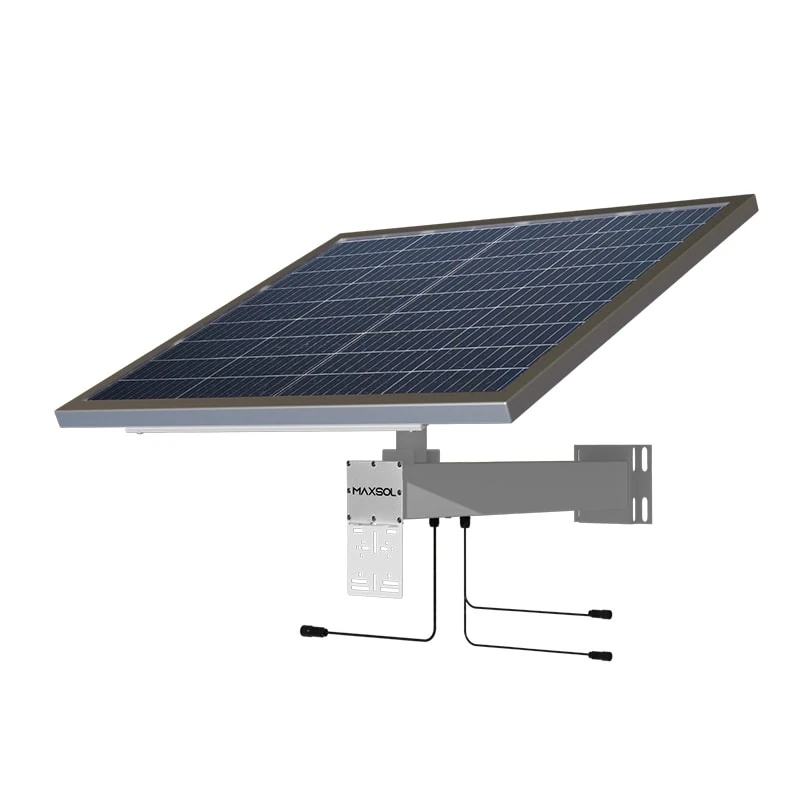
The following Maxsol solar system options provide a useful comparison of nominal LiFePO4 battery capacity. These figures are stored-energy ratings, not guaranteed CCTV runtime figures. Select only after calculating the actual load, required autonomy and available solar recharge.
| Solar system | Battery specification | Nominal energy | Selection consideration |
|---|---|---|---|
| 60W 30Ah 384Wh solar system | 12.8V, 30Ah LiFePO4 | 384Wh | A smaller nominal energy option for loads with a carefully verified energy budget. The CS6030 documentation includes MPPT control. |
| 80W 45Ah 576Wh solar system | 12.8V, 45Ah LiFePO4 | 576Wh | Provides a higher nominal storage figure where the calculated load and autonomy requirement exceed 384Wh. |
| 120W 60Ah 768Wh solar system | 12.8V, 60Ah LiFePO4 | 768Wh | Consider where a larger calculated overnight or poor-weather energy reserve is required. |
| 200W 100Ah 1280Wh solar system | 12.8V, 100Ah LiFePO4 | 1280Wh | The largest nominal energy figure in this comparison; assess recharge capability, enclosure space and total site demand alongside capacity. |
The progression from 384Wh to 1,280Wh shows why Wh is valuable for comparison. It does not establish the correct choice for a specific camera system. The selected capacity must still be checked against battery reserve settings, connected load, night-time behaviour and solar input at the intended mounting location.
Questions to verify with the system designer
Before approving a LiFePO4 battery for solar CCTV, ask for clear answers to the following:
- What is the average and maximum load in watts, including cameras, infrared illumination, PoE and communications?
- Is power demand calculated separately for day and night operation?
- How many hours or days of autonomy are required, and why?
- What battery reserve or low-voltage cut-off assumption is used in the calculation?
- What losses are included for PoE delivery, converters, cable length and charge control?
- What solar generation assumptions are used for the site during winter?
- Is the panel free from seasonal shading, and can it be mounted at a suitable orientation and angle?
- Can the solar system recharge the battery after the planned autonomy event within a realistic period?
- What are the approved battery charge and discharge temperature limits?
- How are battery, solar input, load and temperature monitored?
- What happens during low battery voltage, and how will the CCTV and network devices recover?
- Are fusing, isolators, cable sizing, earthing and surge protection specified for the site conditions?
- Is there headroom for an additional camera, higher-resolution stream, wireless link or future PoE device?
Common mistakes include using a camera’s lowest published power figure, ignoring infrared demand, assuming sunny-day generation represents winter performance, and adding equipment after commissioning without revisiting the energy budget.
A LiFePO4 battery can be a sound foundation for 24/7 solar CCTV, but only when capacity, charging and protection are designed as one system. Compare the linked Maxsol models against your port count, load, cable distance, power environment and management requirements before selecting a configuration.